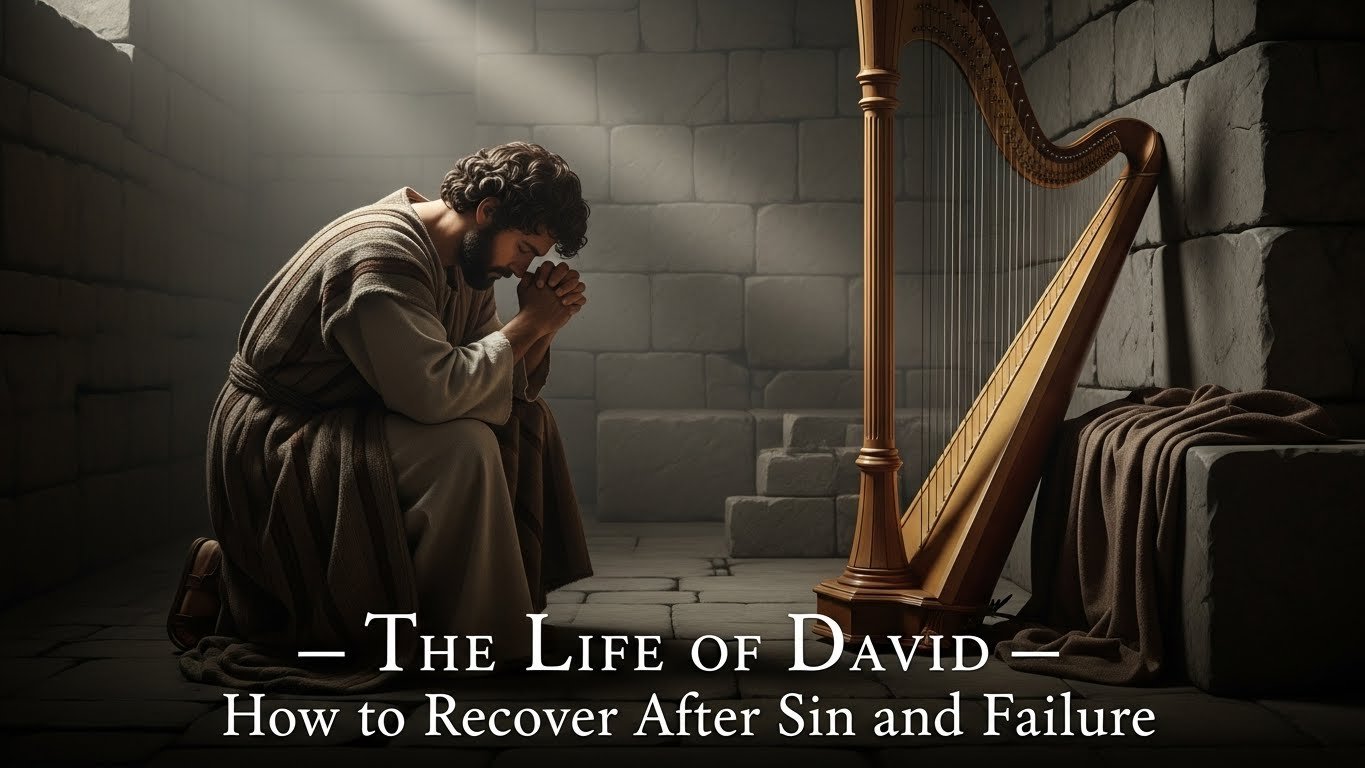

Discover King David lessons on biblical repentance, overcoming failure, and finding restoration through faith, prayer, and hope. A gentle devotional for healing hearts.
There are moments when your mistakes feel bigger than your future. You look at yourself in the mirror and wonder how someone who once believed in God so deeply could fall so badly. The guilt eats at you, and the silence in prayer feels like God has stepped away from you. Many Christians struggle with this feeling—like one mistake, one season of weakness, one sinful decision has permanently disqualified them.
But you are not alone. The life of David shows that God does not abandon broken believers—He restores them, heals them, and raises them again. There is a path back to grace, even after you have fallen.
SCRIPTURAL FOUNDATION
Psalm 51:10 — “Create in me a clean heart, O God, and renew a right spirit within me.”
This verse is David’s cry after his darkest failure. He does not ask God to erase the consequences or pretend the sin never happened; he asks for transformation from the inside out. Many believers want forgiveness without change, but David shows that repentance is deeper than apology—it is surrender. He teaches us that recovery begins not with hiding, but with an honest heart before God, trusting Him to rebuild what was broken.
2 Samuel 12:13 — “Then David said to Nathan, ‘I have sinned against the Lord.’”
When David is confronted, he does not argue, justify, or blame others. He names his sin plainly. Christians often spend months or years trying to spiritually “explain” their failures, instead of confessing them. David shows that true repentance is not trying to look holy—it is acknowledging where you fell and asking God to pick you up.
Acts 13:22 — “I have found David son of Jesse, a man after my own heart.”
David failed, but God still called him His own. This verse proves something many Christians forget: God defines you by your pursuit of His heart, not by your worst mistake. If God can look at David—and still see purpose, destiny, and worship—He can do the same for you.
FAITH TEACHING
David Teaches Us That Repentance Is Not for the Perfect, but for the Broken
When David sinned with Bathsheba, he did not run away from God; he ran toward Him. He cried, fasted, wept, and wrote psalms of confession—not to manipulate God, but to reconnect with Him. Many Christians believe repentance is a punishment, a shameful hiding place. It is actually the doorway to freedom.
When your heart is heavy, the enemy will whisper that God is tired of you. He will convince you to stay silent, to pretend nothing happened, to numb the shame with distractions. But Scripture shows something different: God meets you in confession, not perfection. Recovery begins when you stop pretending you are strong.
Mercy Is God’s Nature, Not His Exception
Christians often imagine God like a strict supervisor: tracking failures, keeping score. But David’s story reveals the opposite. God pursued him after failure, restored him when sin consumed him, and trusted him again with leadership.
Mercy is not a loophole—it is God’s heartbeat. Many believers fall, then exile themselves emotionally: they stop praying, stop singing, stop serving. They think their sin has made them unworthy of His presence. But heaven does not treat sin like a permanent stain. Mercy says: “There is still room for you.”
Consequences Are Real, but They Are Not the Final Word
David faced painful consequences after his sin: loss, grief, family chaos. Repentance does not erase pain; it restores identity. Many Christians think, “If God forgave me, why does life still hurt?” The answer is simple: Forgiveness heals your heart; consequences sharpen your character.
God did not abandon David because of consequences—He walked with David through them. He protected him, counseled him, and raised him again. Your scars do not mean God has rejected you. They mean you survived.
Restoration Comes Through Worship, Not Self-Hatred
David did not remain stuck in Psalm 51. He rose, sang again, led again, built again. The Bible says he became the greatest king of Israel. He did not achieve this by drowning in guilt or hiding in spiritual shame.
Christians often think the “holy” way to repent is to hate themselves. But God does not call you to punish yourself. He calls you to return, rebuild, and worship. Your recovery begins when you lift your eyes from your sin to your Savior.
GUIDED PRAYER SECTION
Short Prayer
Lord, I come to You with my failures.
Take my shame and heal my heart.
Give me the courage to confess and return.
Renew in me the joy of Your salvation.
Restore my hope and rebuild my spirit.
Lead me back to Your presence.
Amen.
Deep Prayer
Father, I am tired of running from the pain of my mistakes. I feel like I disappoint You, like my failures have erased my value. But I lift my heart to You. I come not as someone who has everything figured out, but as someone who is broken, wounded, and in need of Your mercy. Teach me to repent like David—not with fear, but with trust. Let me feel Your grace washing over me, even in the places I am most ashamed of.
Lord, I confess the moments where I chose my own path instead of Yours. I confess the words I regret, the choices I made in weakness, and the things I cannot undo. But I also confess this: I still believe You can renew me. I still believe You can write a new chapter after my failure. Take the parts of my life that feel too heavy, too ruined, too dark—and breathe Your restoration into them. I do not want to live in hiding. Bring me back into Your light.
Help me stand again. Help me worship again. Help me smile again. And when the enemy tells me I am too far gone, remind me of the truth: David fell, but David got up. And I, too, will rise. In Jesus’ name, amen.
Declarations / Affirmations (Spiritual Warfare)
-
I am forgiven and redeemed.
-
I am not defined by my past mistakes.
-
God’s mercy is greater than my failures.
-
I rise again in the strength of the Holy Spirit.
-
My heart belongs to God, not to shame.
-
I walk in restoration, not regret.
-
I am a child of grace.
-
God is not done with me.
-
I choose repentance over hiding.
-
I will worship again.
-
I will rebuild with God’s help.
-
I am loved more than I have fallen.
APPLICATION STEPS
1. Bring your sin to God, not to your shame.
When you fail, your first instinct may be to disappear. This is normal, but unhealthy. Speak to God in the middle of your weakness—He already knows. Prayer does not expose you; it frees you. Shame tells you to stay silent. Grace tells you to confess. Only one leads to healing.
2. Read Psalm 51 slowly—like a mirror.
Instead of skimming Scripture, sit with David’s repentance. Let each line speak to you. When he says “clean heart,” ask yourself what areas of your life need cleansing. When he says “restore joy,” ask what joy you have lost. Scripture becomes transformational when you let it enter your wounds, not just your mind.
3. Surround yourself with truth, not isolation.
David was confronted by Nathan. He was not healed privately; he was healed through godly correction. Find at least one mature believer you can talk to honestly. Isolation feeds temptation—and temptation grows in the dark. A safe community is not a luxury; it is spiritual protection.
4. Worship even when you don’t feel worthy.
Your soul will resist worship after failure. It will whisper, “You are a hypocrite.” Do not listen. Worship is not a testimony of your perfection—it is a declaration of God’s mercy. David wrote psalms after sin because worship helped him breathe again. Let it help you breathe too.
5. Track your emotional recovery.
Journaling is a tool God can use. Write what hurts, what you regret, what you learned. Write prayers, victories, temptations, and breakthroughs. Over time, you will see evidence of growth you cannot feel in the moment. Your healing deserves witnesses—even if those witnesses are your own pages.
ENCOURAGEMENT BLOCK
You may think you have failed God too deeply to be restored, but heaven has not abandoned you. Your tears are not ignored; they are seen, counted, and treasured. God is not finished with you. He does not hold you at arm’s length—He reaches toward you with tenderness.
The same God who restored David will restore you. You may feel weak, ashamed, or exhausted, but love still surrounds you. Grace still flows. Hope is still alive. Healing may come quietly, slowly, or unexpectedly—but it will come.
If guilt is heavy on your heart, explore our Prayer of Release and Forgiveness.
Struggling to trust God after mistakes? Read our Devotional: When God Feels Silent.
If you want deeper Bible reflection, study our Scripture Guide on Spiritual Renewal.
GENTLE CALL TO ACTION
If you are recovering from a difficult season—share your prayer request in the comments.
Let us stand with you, pray over you, and walk this journey of restoration together.
